Norms not rules

I’ve mentioned this before that mixing up norms and rules is annoying. I then immediately feel annoying because it feels as if I am merely being a persnickety philosopher type…but well, that’s a job of philosophers, finding the right words to cut the world at the joints. But it’s not just a technical distinction, I think it informs a lot about social and political attitudes vis a vis things I’ve been talking about the last few entries.
So what are rules versus what are norms? They are both ideas that govern activities and behaviors but rules are prescribed and explicit whereas norms arise out of a community in a more haphazard manner. As an example the rules of chess have largely to do with how each piece moves, what is check, and check-mate etc. The norms of chess are much more squishy - they will differ between a private game and a game in a tournament ie you can probably talk in the former but not at all in the latter.
Many autistic folk talk about the ‘unwritten rules’ of society or social interaction but if these things are unwritten they are in fact norms. They feel like rules because of the reaction neurotypicals tend to give when autistics don’t behave as expected ie there is kind of a disbelief or offense. But it is, in part, an autistic way of thinking that wants to make norms into rules as many autistic people also train themselves into understanding norms as rules because they seem so non-intuitive.
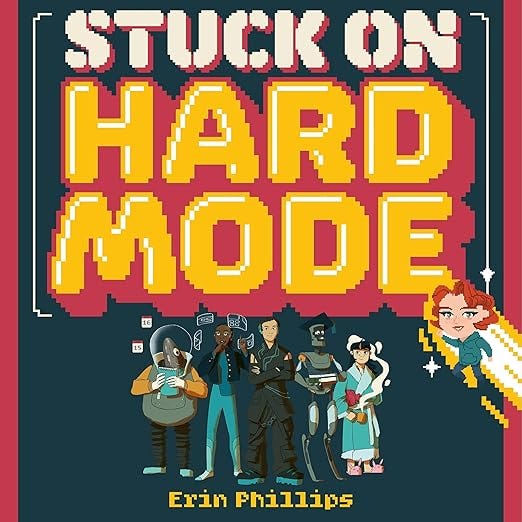
Take Erin Phillips’ book Stuck on Hard Mode (which I heard about because it was recently featured on Autistic AF). The book makes social difficulties (and other things) legible through a DnD kind of logic…an autistic character build only has so much energy/points to distribute across capacities. I think this is helpful, it makes sense, but the conversion of norms into rules works only for a limited time. And, for the record, Phillips does talk about the importance of understanding norms especially in co-op activities so I don’t think the book is guilty of the equation of norms and rules but even the best attempts to avoid this may fall into certain traps. It’s a really nice book…I use it here mostly because it recently crossed my brain.
The use of game-logic can be useful if it emphasizes the arbitrariness of norms. This arbitrary nature is difficult to sell because norms feel like unwritten rules to so many neurodivergent folks (again because of how people treat them when they are being ‘weird’ or ‘cringe.’) Norms are culturally and historically plastic, they did not emerge only from certain assumptions about how social interactions should be, but also in response to certain material/technological conditions.
Some theorists and philosophers treat norms as a functional necessity for society to function. Basically, the notion is a kind of low-key version of the social contract - to get along and be able to get things done collectively we have to have a set of assumptions for how we interact. This is, in part, why autistic folks behavior in an ‘improperly’ constrained manner are seen to be selfish or indignant - causing trouble for the sake of it or for their own pleasure. But the question of why these norms and not others point to at least two things important for neurodivergent folks:
1-Should social norms only shift according to material conditions or does this attitude merely, or mostly, defend the status quo in terms of how social life and collective human activity should be from a limited perspective?
2-The functional take on norms just stated ignores emotional, psychological, and ability differences….it flattens individual needs not in the name of the greater good but just the greater function.
Both of these ideas amount to a ‘don’t rock the boat’ attitude - the first from a kind of capitalist realist perspective and the second from a conservative assumption about the inner life of people in general.
So taking norms as rules strengthens (often unintentionally) the don’t rock the boat attitude because rules seem like something difficult or impossible to change, something that requires bureaucratic revisionary procedures or something like that. It also encourages a defeatist or deflationary attitude which seems to be everywhere in online autistic communities (based on my experience of the last two years or so). Many autistic folks decide to withdraw and say they are doomed (as I’ve mentioned before there is also a worryingly high cross-over between incel/femcel communities and autistic communities). Importantly while tactical withdrawal is necessary for many ND folks and especially autistic folks to avoid burnout, it is not a strategy in and of itself to the extent that it accepts that norms cannot change.
Another related issue is that this rejection of the normies leads into supremacy. Ember Green’s video from last week is great on this. The fuck the world attitude can lead to some dubious uses of evo-psych or other means of naturalizing norms as biological such that autistic folks are ‘more evolved’ and should therefor move fast and break things. I’m obviously referencing the alt-right and tech-bro romanticization of neurodivergence as a tool or weapon which Robert Chapman wrote about here recently.
Norms can be changed but largely indirectly. If people do not see ND behavior it will continue to be judged harshly. There is a discrepancy between normative expectations and normative beliefs…people may not care about something ‘abnormal’ after they see it or vice versa. An awful lot of thinking about norms, unfortunately, seems trapped in a very old fashioned account of evolutionary game theory and reduces the effects of what is actually perceived as norms as affecting norms themselves. From the game theory perspective autistic and other ND folks would have ‘mutant norms.’ I think this is something to claim instead of doom scrolling ‘unwritten rules’ I’m gonna refine my mutant norms.